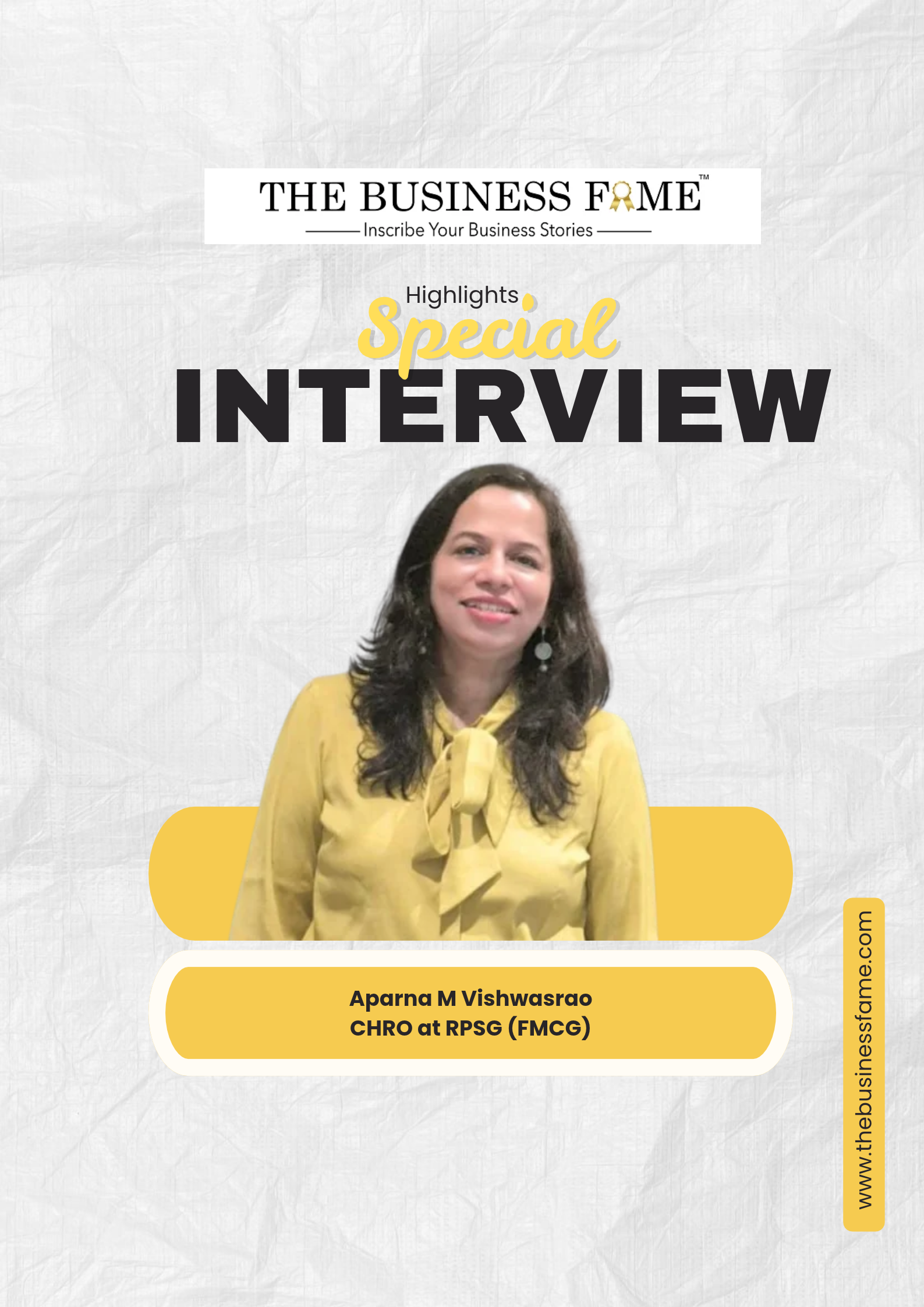
Aparna M. Vishwasrao is a seasoned HR leader and corporate professional with over 25 years of experience spanning pharmaceuticals, FMCG, consumer care, BFSI, and diversified conglomerates. Throughout her career, she has played a significant role in building five organisations from the ground up while leading business transformations, organisational turnarounds, and post-merger integrations.
With a strong understanding of the intersection between business strategy and human potential, Aparna has championed strategic HR initiatives across talent management, leadership development, succession planning, diversity and inclusion, and organisational effectiveness. Her experience includes leading complex transformation initiatives at Raymond Consumer Care, driving pioneering talent initiatives at MSD, and partnering with Boards on succession planning and rewards governance. She strongly believes that HR must go beyond traditional people management to become a strategic enabler of business growth, organisational resilience, and long-term value creation.
Passionate about continuous learning and innovation, Aparna advocates a transparent, collaborative, and performance-driven leadership approach. Outside her professional commitments, she enjoys writing, reading, travelling, and yoga, which continue to shape her curiosity and perspective on life and business.
Featured in The Business Fame Magazine‘s exclusive interview, Aparna shares insights into her extensive HR leadership journey, experiences in business transformation and organisational integration, perspectives on technology-driven HR practices, and her vision for building agile, resilient, and future-ready organisations.
- For our readers, how would you like to introduce yourself and the work you are most passionate about?
I describe myself as a corporate traveller – an ardent student of both life and business. Across more than 25 years in HR leadership spanning Pharma, FMCG, Consumer Care, BFSI and diversified conglomerates, I’ve had the privilege of building five organisations from the ground up, alongside leading transformation in more established ones. What I remain most passionate about is using my profession as a lever for growth – not just for the business, but for the people within it and the communities we touch. HR, done well, sits at that intersection: it is where business ambition meets human potential. Outside of work, I hold onto that same student mindset through writing, reading, travel and yoga – each of which, in its own way, keeps me curious and grounded.
- What experiences have shaped your leadership philosophy across pharmaceuticals, FMCG, consumer care, and D2C businesses?
My leadership philosophy has been shaped by a simple, hard-won belief: success is never final, and failure is never fatal – what matters is the courage to keep experimenting and taking calculated risks. Leading a defined, courageous set of decisions during Raymond’s post-merger integration and subsequent divestiture, in the middle of the pandemic, taught me what it means to lead from the front when the stakes and the uncertainty are both at their highest. Conceptualising and implementing pioneering global and local talent initiatives at MSD, while helping drive the business’s turnaround and growth, reinforced another conviction I carry into every role: that HR strategy only earns its place at the table when it creates a genuine win-win for both business outcomes and people outcomes – never one at the cost of the other.
- What HR strategies have been most effective in connecting people performance with business growth and EBITDA improvement?
The starting point is always the organisation’s vision and mission – HR strategy has to be evolved in sync with the business plan and its key drivers, not built in parallel to it. From there, I work with my teams to arrive at the key pillars of the HR plan, each with clear timelines, single points of accountability, measurable metrics and a disciplined review mechanism. This is what turns HR from an activity into a strategy. That said, I hold one belief firmly: HR can meaningfully influence positive EBITDA, but it cannot single-handedly deliver it. Business growth is a team game. HR’s role is to be a powerful enabler of that outcome – and treating that enabling role with the seriousness it deserves is itself one of HR’s most important duties.
- How do you build organisational agility and resilience during periods of transformation and turnaround?
It begins with tremendous clarity – on the vision and the goals – because agility without clarity simply produces motion, not progress. From there, I build a plan that is flexible by design, with clear accountability and timelines, and I insist on impeccable execution. People say the devil is in the details; I’ve come to believe God is in the greater details. Beyond the plan itself, resilience is ultimately a human capacity – so I invest deliberately in building people’s capability to adapt to change, sensitising them to what’s ahead, communicating transparently about the trade-offs involved, and ensuring the rewards for navigating that change are visible and fair. Organisations don’t become resilient by accident; they become resilient because their people have been equipped and trusted to be.
- What key lessons did you gain from leading post-merger integration and transformation at Raymond Consumer Care?
Leading RCCL through its build, turnaround, and eventual due diligence and divestiture to Godrej Consumer – one of the largest FMCG transactions of its time – taught me that deep business understanding is non-negotiable for an HR leader; you cannot drive people strategy credibly without first understanding the commercial reality you’re operating in. Equally, it taught me to take the team along rather than move ahead of them, to stay agile even while holding a well-defined plan, and that patience and stamina matter just as much as urgency during a prolonged transformation. Above all, it reinforced the importance of staying relentlessly focused on the target, convincing stakeholders at every step, and having the courage to take bold steps when the moment demanded them – while never losing sight of the plan’s discipline.
- How do you approach M&A, organisational integration, and cultural alignment from a people perspective?
I work off an overarching framework that connects three layers: the business goals of the merger, the specific merger goals and timelines, and the execution of every HR process and communication needed to get there. Within that framework, the practical work spans organisation design, culture, compensation and benefits, and every allied HR process – all of which need deliberate harmonisation across the merging entities. Two disciplines matter more than any other in this work: communication – over-communicating, not under-communicating – and transparency, backed by rigorous, compliance-driven processes. I also make it a point to go to the ground, to meet people where they are and resolve their doubts and questions directly, rather than letting integration anxiety travel unaddressed through the organisation. I carried this framework through MSD’s integration of two global mergers, and it has held up consistently since.
- What role do HR technology, digitalisation, and data-driven insights play in building future-ready organisations?
I’d go so far as to call it the basic oxygen for survival and growth today. An ERP brings fragmented people data under one roof, giving leaders a single source of truth instead of scattered spreadsheets. Beyond that, tools like SFA platforms drive frontline productivity and discipline, structured learning platforms build capability at scale, and AI-enabled chatbots and allied tools are increasingly improving everyday productivity across the HR function itself. I’ve seen this evolution first-hand – from early PeopleSoft and SAP ERP implementations earlier in my career to today’s AI-enabled tools – and the pattern holds: technology doesn’t replace HR judgment, but it removes the friction that keeps HR leaders from applying that judgment where it matters most.
- How have you approached talent, rewards, succession planning, diversity and leadership development across complex organisations?
My approach across all of these is consistent: define a clear approach, secure genuine buy-in from business leadership, build a robust plan, and then execute with discipline. Diversity and inclusion is a good example of how this plays out in practice – it has to emanate from the business vision and a genuine business requirement, not a policy mandate alone; when it’s linked back to business need, it holds far more weight. At MSD, for instance, we anchored our D&I work in a clear ‘why’ before setting goals, metrics, initiatives and timelines around it. Ultimately, I’ve come to believe diversity is as much a feeling as it is a set of metrics – people need to feel it as much as see it reflected in numbers. The same rigour has shaped my work on succession and rewards governance, including a decade partnering Boards and NRCs on both.
- What has been your approach to managing Industrial Relations while maintaining trust, productivity, and business continuity?
I think about IR at two distinct levels – operational and strategic – and both need equal attention. Operationally, it’s the day-to-day discipline: statutory returns, court matters, and a clear checklist that ensures nothing slips. Strategically, it is about managing the external environment – including unions – and also about the philosophy you bring to that relationship, because philosophy is what determines how you handle the moments that matter most. A win win approach for business and people keeping profitability in mind , certain non negotiable values and education and sensitisation are the pillars of this approach . That strategic lens has guided me through driving critical initiatives such as de-unionisation – including leading a complex 700-person de-unionisation to managerial cadre – and ensuring long-pending settlements are resolved and executed with discipline, across 40+ manufacturing sites over the course of my career; also averting attempts to form a union when even th workers were not keen in an changing industrial landscape . Trust, in my experience, is built less in the negotiation room and more in how consistently you follow through afterward.
- Looking ahead, what emerging HR trends and leadership priorities do you believe will shape the future of organisations?
I see a few shifts becoming impossible to ignore. First, AI and people analytics are moving HR from being reactive to being predictive – the organisations that win will be the ones using data to anticipate talent and capability gaps, not just report on them after the fact. Second, skills are overtaking rigid roles and job titles as the real currency of organisational planning, which means continuous reskilling needs to become the default state of a workforce, not an occasional intervention. Third, leadership itself is being redefined around human-centricity – balancing productivity and performance with genuine employee wellbeing, especially as hybrid and distributed work becomes permanent rather than temporary. And finally, I believe the CHRO’s own role will keep evolving from a support function into a true growth co-pilot to the CEO – someone who sits as close to business strategy as the CFO does. Organisations that recognise this shift early will be the ones genuinely future-ready.