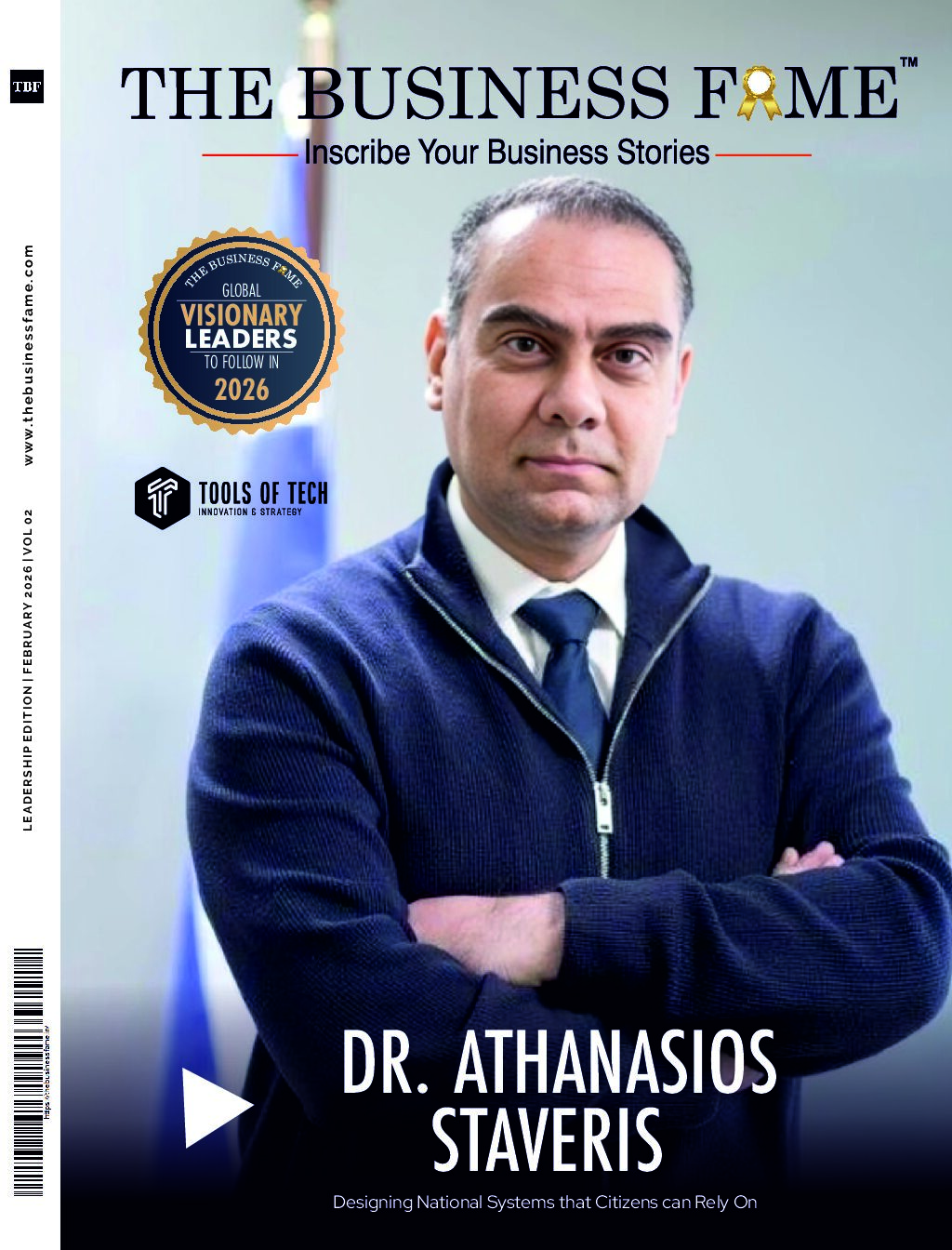
In an era where nations rely on invisible systems as much as physical ones, the real challenge of digital transformation lies not in technology itself, but in trust. Communications networks, data platforms, cybersecurity frameworks, and public digital services now sit at the heart of economic stability, national security, and everyday life. Governments are expected to move fast, innovate responsibly, and remain resilient in the face of constant disruption. Few roles demand a clearer blend of scientific rigor, public accountability, and operational realism. It is at this intersection that Dr. Athanasios Staveris-Polykalas has built his career.
Trained as a physicist and shaped by hands-on experience in large-scale transformation, Dr. Staveris-Polykalas has spent his professional life turning advanced technology into trusted national capability. His work spans public service, critical infrastructure, and innovation, always grounded in a simple but demanding mission: ensuring that progress is not only ambitious, but secure, measurable, and beneficial to society.
Over four years in the public sector, he played a central role in the digital transformation of the Hellenic State. Working closely with the Minister of Digital Governance and a broad ecosystem of stakeholders, he contributed to the design, delivery, and oversight of major digital policies and initiatives. As Secretary General of Telecommunications and Posts, he carried responsibility for the development and modernization of national telecommunications and postal infrastructure, while also overseeing market coordination and regulatory alignment. The role required balancing long-term strategy with day-to-day operational realities, where continuity of service, resilience, and public trust were non-negotiable.
Before that, his work as a Technology Advisor to the Government placed him at the frontline of data-driven governance. Drawing on expertise in big data analytics and artificial intelligence, he supported evidence-based decision-making across complex policy domains. His scientific background proved decisive. Holding a PhD in High Energy Physics from the National and Kapodistrian University of Athens, he approached public challenges with the same discipline he once applied to theoretical problems: defining assumptions clearly, testing them rigorously, and remaining guided by evidence rather than opinion.
Alongside his public service, Dr. Staveris-Polykalas has maintained strong ties to research and innovation. He has authored multiple publications in leading scientific journals, holds advanced certifications in machine learning and deep learning, and continues to engage deeply with emerging technologies. His fluency in English and international exposure have supported collaboration beyond national borders, including winning the EU Datathon in 2017 alongside a co-founder of C4P.io.
Across cybersecurity, digital public services, next-generation communications, and national resilience planning, his focus remains consistent. Modernization, in his view, must improve citizens’ daily lives, strengthen economic competitiveness, and enhance sovereignty and continuity at the same time. Today, through his work at Tools of Tech PC and in advisory and board-level roles, he continues to bridge policy, engineering, and risk governance, helping institutions innovate with confidence and deliver outcomes that last.
From Scientific Rigor to Public Leadership
Dr. Staveris-Polykalas traces much of his leadership philosophy back to his early years in scientific research. That formative period instilled habits that still guide his work today: disciplined reasoning, respect for evidence, and a constant willingness to test assumptions before acting.
In complex public systems, he observed early on that clarity is often the rarest resource. Policies fail not because of a lack of intent, but because problems are poorly defined and dependencies are misunderstood. This realization shaped his methodical approach. He starts with fundamentals, isolates the real issue beneath the noise, maps how systems interact, and then builds solutions that people can realistically carry out.
Equally important was another lesson research taught him. Effective leadership does not hinge on individual brilliance. It depends on creating conditions where teams can make sound decisions under pressure. In public institutions, that means establishing a shared way of working, aligning incentives, protecting time for focused thinking, and staying closely connected to those on the frontline. He learned that transparency, fairness, and compliance are not obstacles to progress. They are the foundations that make lasting transformation possible, especially where public legitimacy is at stake.
Why Early Warning and National Resilience Matter
Dr. Staveris-Polykalas’ focus on early warning systems grew from a clear understanding of how modern risk behaves. Today’s threats rarely arrive in isolation. Cyber incidents, supply chain failures, disinformation campaigns, natural disasters, and geopolitical shocks often unfold together, moving rapidly through interconnected infrastructure.
In his experience, resilience is less about the size of a country’s budget and more about its ability to see clearly and act in unison. Nations that respond well are those with strong visibility across systems and the coordination to move decisively when signals begin to emerge.
He views early warning not as a standalone technology, but as a governance capability. It requires data to flow across sectors, clear escalation paths, practiced response protocols, and leadership comfortable making decisions with incomplete information. True resilience shows itself in the ability to keep essential services running, absorb shocks without panic, recover quickly, and improve with each disruption. When early warning functions as intended, it reduces human and economic harm while reinforcing public confidence in institutions.
AI as a Decision Partner, Not a Shortcut
In government and critical infrastructure, Dr. Staveris-Polykalas sees artificial intelligence as a powerful enabler when treated with the seriousness reserved for safety-critical systems. Used responsibly, AI can sharpen situational awareness by detecting anomalies, forecasting demand, prioritizing risks, optimizing maintenance, and supporting faster responses during incidents.
Yet he remains cautious of adopting technology for its own sake. The goal is not blind automation, but informed augmentation. AI should strengthen human judgment by offering timely analysis, credible scenarios, and clear decision support.
That approach demands strong governance. Data quality must be controlled, cybersecurity risks actively managed, and accountability clearly assigned. Bias testing, audit trails, and explainability are essential, particularly in high-impact public decisions. He strongly supports human-in-the-loop models where technology assists but does not replace responsibility. When deployed with transparency and discipline, AI can improve performance while deepening trust rather than eroding it.
Principles that Guide the Boardroom
Across his board responsibilities, Dr. Staveris-Polykalas relies on a consistent set of principles to navigate complexity. The first is fiduciary responsibility. Strategic decisions must safeguard the institution’s mission, continuity, and long-term value, rather than chasing short-term perception.
Risk-based prioritization follows closely. He expects risks to be explicitly identified, documented, and debated, particularly in areas such as cybersecurity, operational continuity, and regulatory exposure. Strategy, in his view, only matters if it leads to execution. That means clear ownership, defined timelines, and measurable outcomes.
Resilience is treated as a design requirement, not an optional add-on. Redundancy, preparedness, and recovery capabilities are seen as strategic assets. Underpinning all of this is integrity. Governance must withstand scrutiny because public trust, once damaged, is difficult to restore. These principles have shaped his work as an Independent Non-Executive Board Member at the Hellenic Development Bank and across other institutional roles, anchoring decision-making in responsibility, realism, and long-term public value.
Turning National Ambition into Operational Reality
Dr. Staveris-Polykalas describes his tenure as Secretary General of Telecommunications and Posts as an intensive lesson in execution. Ambition at the national level, he learned, only carries weight when matched by infrastructure that works, procurement processes that deliver, and people who have the skills to operate at scale.
Even the strongest digital strategies can quietly stall when confronted with aging systems, fragmented ownership, or supply constraints. Those realities sharpened his conviction that policy must be designed with delivery in mind from day one. Strategy, in public systems, lives or dies in implementation.
Another defining lesson was the strategic nature of communications infrastructure itself. Spectrum, networks, and service continuity sit at the heart of emergency response, economic stability, and social cohesion. That reality pushes cybersecurity and resilience out of the technical back office and firmly into boardroom responsibility.
Alignment emerged as the final critical factor. Progress depended on coordination among regulators, operators, ministries, and society at large. Above all, trust had to be deliberately built through clear rules, transparent processes, and consistent results. In public service, credibility does not come from announcements. It is earned through outcomes.
Moving Fast without Losing Trust
When asked how countries can pursue rapid digital transformation without undermining regulation or public confidence, Dr. Staveris-Polykalas points to risk-proportionate governance. Speed, in his view, should follow clarity. Where benefits are obvious and risks manageable, momentum matters. Where systems are critical, irreversible, or high impact, deeper assurance is non-negotiable.
He rejects the idea that regulation slows progress. Instead, he sees it as a confidence framework that enables adoption by defining expectations around security, privacy, accountability, and performance. When rules are clear, innovation accelerates rather than stalls.
In practice, this balance requires security and privacy to be built into systems from the outset, not added later. Independent testing, continuous monitoring, strong incident response, and business continuity planning all play a role. Honest communication with citizens matters just as much. People need to understand what is changing, why it matters, and how their rights are protected. Trust grows from reliable services, transparent governance, and visible accountability when failures occur.
The Mindset Behind Critical National Infrastructure
Leading large-scale infrastructure and national assets calls for a mindset grounded in both vision and restraint. Dr. Staveris-Polykalas believes leaders must think in systems, recognizing interdependencies, cascading risks, supply limitations, and human behavior as integral parts of operational reality.
Decision-making under uncertainty is unavoidable at this scale. What matters is pairing decisiveness with evidence, rehearsed scenarios, and measurable controls. Two capabilities stand out as essential.
The first is resilience leadership. Infrastructure must be designed for continuity, redundancy, and recovery, not just efficiency. The second is multi-stakeholder alignment. National assets span government, industry, regulators, and citizens, requiring shared roadmaps and aligned incentives.
Crisis leadership, in his experience, is defined by calm and consistency. These systems are always on, which means cybersecurity, safety, and reliability must be treated as continuous disciplines. The mindset is long-term, mission-anchored, and deeply accountable, shaped by the understanding that failure affects society as a whole.
Innovating with Discipline and Accountability
Dr. Staveris-Polykalas approaches innovation in public service with structure rather than impulse. His guiding principle is simple: experiment responsibly, scale deliberately. He supports rapid prototyping and pilot programs, but only within clear boundaries that define objectives, risks, and success criteria.
Innovation, in his view, is not about novelty. It is about delivering better outcomes under defensible governance. Accountability begins with transparency, documenting assumptions, decisions, and trade-offs while ensuring legal and ethical compliance at every stage.
Independent validation plays a central role, particularly where citizens’ data and essential services are involved. Security testing, performance benchmarking, and auditability are treated as necessities, not formalities.
Underlying every decision is what he calls a citizen impact lens. If a solution cannot be explained clearly in terms of public value, risk, and safeguards, it is not ready for deployment. Innovation earns legitimacy only when it strengthens institutions, protects rights, and delivers measurable improvements that people can trust.
The Global Risks that will Define the Next Decade
Looking ahead, Dr. Staveris-Polykalas believes the most pressing risks leaders must confront are those that compound across sectors rather than remain isolated. Cybersecurity stands at the center of this landscape, not only because of direct attacks, but because of deep systemic vulnerabilities embedded in interconnected infrastructure.
Artificial intelligence adds another layer of complexity. While its potential is undeniable, so are the risks. Misuse, automated disinformation, faster threat development, and weak governance frameworks all have the capacity to erode institutional trust. Alongside this, cryptographic transition pressures and the strategic consequences of emerging quantum-era capabilities demand early and serious attention.
Technology, however, is only part of the picture. Climate-driven disruption will increasingly strain infrastructure and public services. Fragile supply chains will challenge continuity and procurement. Geopolitical volatility will place sustained pressure on energy systems, communications networks, and logistics.
Across all of these threats, he sees a unifying response: resilience. Detection, rapid response, continuity planning, and recovery capacity must be treated as core capabilities. Leaders who succeed will view resilience as a long-term national investment tied to competitiveness and social stability, rather than a regulatory obligation to be satisfied on paper.
Preparing Leaders for the Intersection of Technology and Policy
Future leaders, in Dr. Staveris-Polykalas’ view, must develop what he calls bilingual fluency. They need enough technical depth to challenge assumptions and ask meaningful questions, paired with strong policy literacy to navigate legal, ethical, and institutional realities.
He believes preparation should focus on three core disciplines. The first is risk governance, spanning cybersecurity, privacy, safety, and operational continuity. The second is systems thinking, which enables leaders to understand interdependencies, feedback loops, and unintended consequences. The third is execution leadership, the often-overlooked ability to turn strategy into delivery through procurement discipline, stakeholder alignment, and measurable results.
International awareness is equally important, as standards, regulation, and threat environments increasingly operate beyond national borders. Beyond skills, he emphasizes character. Integrity, composure under pressure, and a willingness to accept responsibility remain decisive traits.
At its core, the intersection of technology and policy is about people. Citizens, users, and operators experience the outcomes of every decision. Leaders who communicate clearly, build trust, and focus on improving lives rather than showcasing innovation will have the greatest impact.
A Message to the Next Generation of Purpose-Driven Leaders
When addressing young people who aspire to lead with purpose, Dr. Staveris-Polykalas keeps his message straightforward. Build substance, protect your values, and remain useful. While technology evolves rapidly, integrity, discipline, and curiosity retain their power over time.
He encourages young leaders to invest deeply in fundamentals such as mathematics, logic, communication, and teamwork before choosing areas of specialization with intent. Mentorship matters, but so does early responsibility. Small projects executed well create credibility that compounds over a career.
He cautions against confusing visibility with impact. Leadership, as he defines it, is a form of service. It is about improving systems, solving real problems, and protecting people from harm, especially those most exposed to risk. In a world filled with noise, clarity becomes a competitive advantage.
Resilience, he adds, is essential. Setbacks and uncertainty are inevitable, but they also accelerate learning when approached with humility. The future, in his view, belongs to those who combine competence with character and choose courage when it matters most.