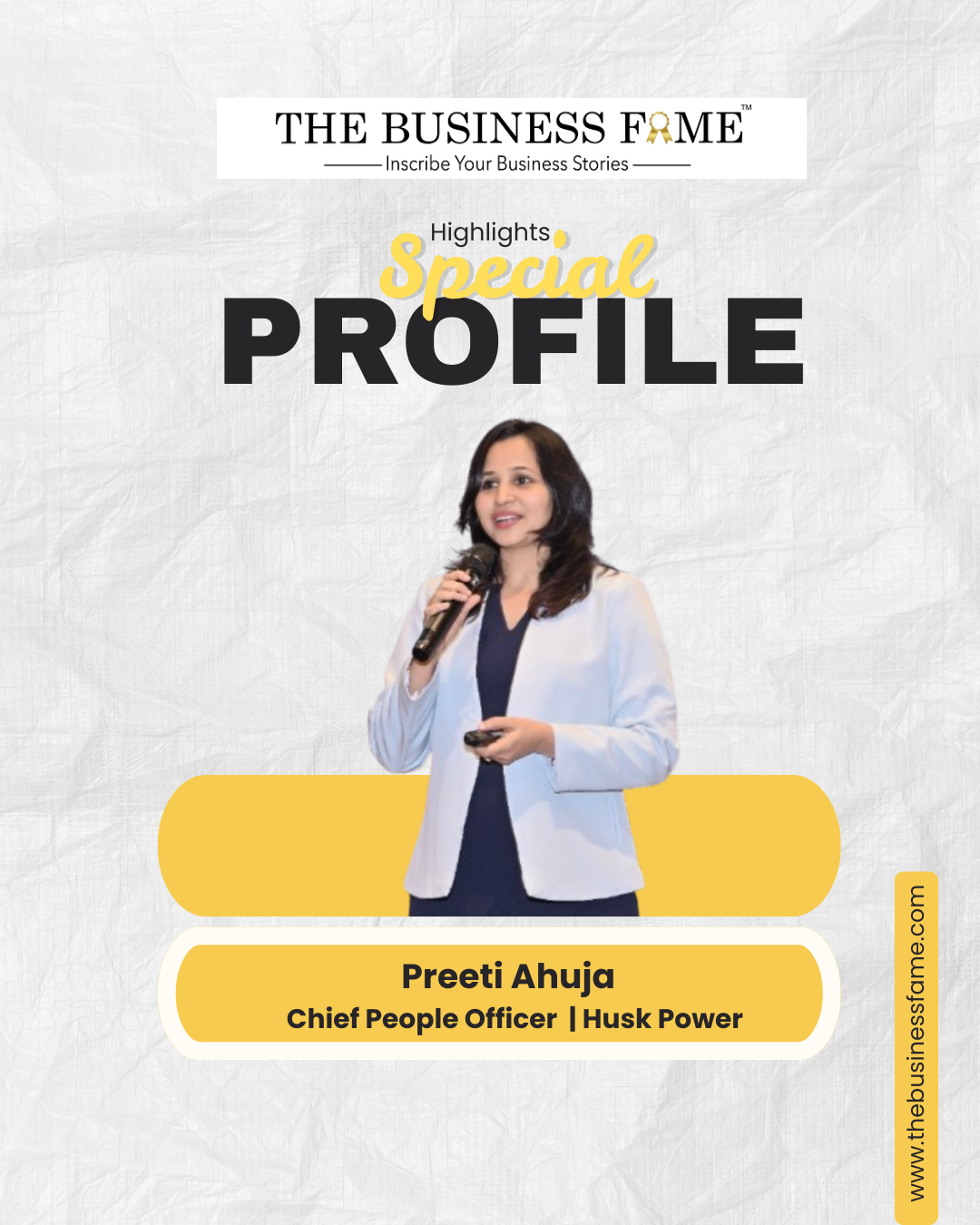
The Business Fame Magazine proudly features an exclusive interview with Preeti Ahuja, Global CHRO, TEDx Speaker, Leadership Coach, and Mentor for Change with NITI Aayog, in recognition of her impactful leadership in people and culture transformation. In this special feature, Preeti shares insights from her remarkable journey as an influential HR leader and strategic business partner, highlighting her commitment to driving organizational excellence, fostering innovation, and building inclusive, high-performance workplaces that empower individuals and deliver meaningful business outcomes.
Interview Questions:
For our readers, how would you like to introduce yourself and the work you are most passionate about?
Knowing yourself is the beginning of all wisdom. — Aristotle
If I were to introduce myself beyond titles and designations, I would say I am a lifelong learner of human behaviour, growth, and self-awareness. Over the years, I have come to believe that true leadership is not built through position or power — it is built through reflection. We all make mistakes; what differentiates us is our willingness to pause, introspect, and evolve. Learning, for me, has never been about acquiring information. It has been about transformation — becoming more intentional in my choices, more patient in uncertainty, and more compassionate in how I lead and live.
With over two decades of HR leadership across global organizations such as Atlas Copco, Alfa Laval, Lear Corporation, Emerson, VMware, and Larsen & Toubro, my journey has been as much about inner evolution as organizational transformation. I have learned that as responsibility expands, the leader must expand first — with deeper emotional intelligence, sharper judgment, and uncompromising integrity.
As a trusted partner to C-suite leaders, I align executive teams around people strategies that accelerate growth, innovation, and organizational agility. I focus on embedding purpose into culture, activating inclusive talent experiences globally, and building leadership capability that drives both business performance and meaningful environmental and social impact.I am most passionate about building workplaces where human dignity is non-negotiable — where people feel psychologically safe, where inclusion is lived, and where performance does not come at the cost of well-being.
Beyond my corporate role, my work as a leadership coach and mentor, including my association with NITI Aayog, reflects my deeper purpose: helping individuals expand their awareness and step into their highest potential. Whether it is guiding leaders, supporting multi-generational teams including Gen Z, or integrating technology without losing the human touch, my focus remains the same — to create environments where both organizations and individuals grow consciously.
What key moments or experiences have played an important role in shaping your journey so far?
My path to becoming a Chief People Officer has been an incredible adventure filled with challenges, growth, and moments of self-discovery. Looking back, I can confidently say that one key habit has consistently propelled my career forward and played a pivotal role in shaping my accomplishments: being true to myself.
In a world where conformity often seems like the easiest route to success, embracing authenticity can sometimes feel like a risky choice. It’s about knowing who you are, understanding your values, and having the courage to stay true to them. It’s about being adaptable and open to change while maintaining a strong sense of self.
By being open, honest, and genuine in my interactions with others, I fostered connections built on trust and mutual respect. These relationships have been instrumental in my career growth, opening doors and providing invaluable support during challenging times.
My collaboration skills, a cornerstone of effective leadership, has also been greatly enhanced by authenticity. Instead of imposing my ideas or solutions on others, I’ve learned to ask a simple yet powerful question: “What are you trying to accomplish, and how best can we get there together?” This approach has not only improved team dynamics but has also led to more creative and effective solutions.
What values or principles guide you in both your professional and personal life?
At this stage of my journey, the principles that guide me are deeply anchored in awareness, intention, and integrity. In a world that often equates speed with success, I have learned that meaningful progress requires clarity of thought and alignment of purpose.
One value that shapes both my leadership and personal life is clarity through language. I have seen how misalignment in vocabulary leads to misalignment in strategy. Early in my career, while leading cross-functional teams across global geographies, I realized that many conflicts were not capability issues but communication gaps. Expanding my vocabulary — not just linguistically but conceptually — expanded my thinking. The words we use frame how we interpret reality.
Another principle I hold strongly is that life and leadership are rarely binary. Very few decisions are simply right or wrong; most exist on a spectrum of trade-offs. Over time, I have shifted from asking “Is this good or bad?” to asking “To what extent does this serve our long-term purpose?” Embracing nuance allows me to replace judgment with discernment — an essential capability when balancing business performance with people well-being.
I also believe in competing with purpose, not with people. Comparison without context can dilute focus. Instead of measuring success against others, I define it by alignment with values and impact. In organizations, this translates into building cultures where individuals strive for excellence not out of fear or rivalry, but from intrinsic commitment.
Leadership, for me, is not just about driving results; it is about refining the inner compass that guides those results. When purpose and principles align, performance becomes sustainable — and impact becomes meaningful.
What challenges have taught you the most, and how did you turn them into learning experiences?
As I think back on my life journey, I can’t help but acknowledge the lessons that have shaped me. These lessons have left an indelible impression on me and have helped me become the person I am today.
Embrace Failure as a Stepping Stone to Success
One of the most important lessons I have learned is to embrace failure. In my early twenties, I started sitting in competitive examinations, full of ambition and dreams of success. I was disappointed to find that my initial effort was a total flop. I felt like a complete failure, as if I had nothing to offer. But looking back, I realize that failure taught me invaluable lessons about perseverance, determination, and the importance of learning from our mistakes. I learned that failure is not the end, but a stepping stone toward success.
Failure is not a reflection of our worth, but an opportunity for growth and improvement.
Practice Gratitude and Appreciation
Life has a way of getting busy and overwhelming, making it easy to take things for granted. It was during a difficult period in my life when I realized the power of gratitude. Seeing things from a different perspective brought me a sense of peace, and I could find the strength to overcome adversity. Practicing gratitude and appreciation allows us to shift our focus from what we lack to what we have. It promotes a positive mindset and helps us find joy and contentment in the present moment.
Practice Self-Care and Prioritize Your Well-being
In today’s hectic world, it’s essential to make our well-being a top priority. I experienced burnout from trying to balance too many responsibilities and learned a valuable lesson. Taking time for myself rejuvenates my mind, body, and soul, allowing me to show up fully in all aspects of my life. When we take care of ourselves, we are better equipped to show up for others and make a positive impact on the world.
How do you define success today, and what kind of impact do you strive to create through your work?
At this stage of my journey, I define success not merely by outcomes, but by the values that endure long after outcomes are achieved. Financial performance is essential, but it is not sufficient. True success lies in building institutions that are principled, resilient, and capable of sustaining excellence without compromising human dignity.
As leaders, we do not just manage functions — we shape cultures. Whether in our professional roles or personal lives, we influence mindsets much like a parent or mentor influences the next generation. The question is not whether we will leave a legacy; the question is what kind of legacy we choose to leave. For me, it is about establishing systems rooted in fairness, accountability, empathy, and long-term thinking.In today’s environment — defined by technological acceleration, AI-driven transformation, hybrid work models, and the expectations of Gen Z — success must integrate both digital intelligence and emotional intelligence. Technology can optimize processes, but only emotionally intelligent leadership can build trust. Remote work has shifted leadership from control to credibility; it now demands clarity of purpose, outcome-based accountability, and deeper intentional communication.
Equally, mental well-being is no longer a peripheral conversation — it is a strategic priority. Sustainable performance requires psychological safety. The impact I strive to create is an ecosystem where performance and principles coexist — where technology enhances efficiency without eroding connection, where multiple generations collaborate with mutual respect, and where leaders are developed not only for capability but for character. If the organizations I help shape can grow profitably while remaining inclusive, ethical, and human-centered, and if the leaders emerging from these systems carry forward those values, I consider that meaningful success.
Ultimately, success for me is about stewardship — leaving behind stronger systems, stronger leaders, and stronger values than we inherited.
What one meaningful message would you like to share with today’s youth and aspiring changemakers?
Today’s HR leaders must understand business dynamics, leverage data and AI-driven insights, and foster a culture of inclusivity and innovation. Be willing to take risks and be uncomfortable. Don’t wait to finish the work you are doing to move into a new role. Define the fingerprints that you want to leave on an organization and hold yourself accountable for making them happen. Proactively seek feedback from a variety of stakeholders as committing to your continuous development is essential for growth. And most importantly, always remember that people are the one thing that truly distinguish great companies. Invest heavily in people and culture because, in the end, strategic execution cannot happen without aligned and engaged colleagues working together in an inspiring and compelling cultural environment. Surround yourself with mentors, diverse perspectives, and environments that challenge your thinking. True changemakers are not defined by the positions they hold, but by the values they uphold and the people they elevate along the way.